Part 1
I had always believed that quiet neighborhoods kept quiet stories.
That was one of the reasons I had moved to suburban Ohio in the first place.
Five years earlier, I had been tired of apartment walls thin enough to hear arguments through them, traffic that never seemed to sleep, and the strange feeling of living among hundreds of people without knowing the name of a single one.
The subdivision I found was different.
It wasn’t perfect. The houses were built close together, the sidewalks were cracked in places, and every autumn the same stubborn leaves seemed to collect along the storm drains. But the streets were calm. Children rode bicycles in the afternoons. People waved when they drove past.
And on my particular cul-de-sac, everyone seemed to know everyone.
At least, that’s what I thought.
There were only eight houses arranged around a small circular street. We had the Millers at one end, with their two teenagers and an enormous golden retriever. The Petersons lived beside them and seemed to spend half their weekends repairing something in their garage.
Then there was me.
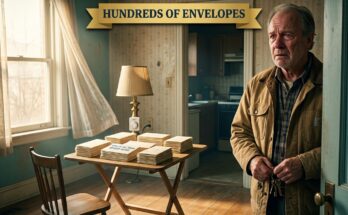
And directly across the street stood the modest gray house belonging to Mr. Henderson.
He was seventy-two years old, a retired high school teacher, and one of those people who seemed to have become part of the neighborhood itself.
His lawn was always neatly cut.
His porch light was always turned on before sunset.
His mailbox was always closed.
And Mr. Henderson was almost always alone.
I had known him since the week I moved in.
He was the first neighbor to introduce himself.
I remember carrying a cardboard box from my car when he crossed the street.
“Need a hand?” he asked.
I looked at the box in my arms.
“Unless you can somehow make this thing lighter.”
He smiled.
“Unfortunately, retirement didn’t come with superpowers.”
That was how our friendship began.
Not a close friendship, exactly.
We never went on vacations together or called each other every night. But there was something comfortable about knowing he was there.
Sometimes we spoke across the street.
Sometimes he stopped while I was checking the mail.
He had a habit of asking questions and then actually listening to the answers.
What did I do for work?
How was my family?
Had I finally fixed the leaking faucet I’d complained about?
He remembered things.
Once, several months after I’d mentioned that my mother was recovering from an illness, he asked, “How’s your mom doing?”
I had forgotten I’d told him.
He hadn’t.
That was Mr. Henderson.
Quiet.
Polite.
Observant.
He had spent more than four decades teaching American history at a local high school, and occasionally I caught him sitting on his front porch with a book.
He never seemed lonely.
Or perhaps he was simply very good at hiding it.
We rarely saw visitors at his house.
I never saw children running in and out.
No grandchildren appeared during holidays.
There were no noisy family gatherings.
Just Mr. Henderson, his gray house, his neatly trimmed lawn, and his old blue sedan parked beneath the carport.
For five years, that was all I knew.
And I thought I knew enough.
Then came Tuesday.
It was an ordinary Tuesday, which somehow made what happened even more unsettling.
I got home in the late afternoon after work and walked toward my mailbox.
The air had begun to cool with the approaching season. The sky was pale, and a light wind moved through the trees lining the street.
I opened the mailbox expecting the usual collection of envelopes.
Utility bill.
Credit card advertisement.
Something from the insurance company.
Junk mail.
I grabbed everything and carried it toward the front door.
Then I noticed the white envelope.
It didn’t have a stamp.
There was no return address.
My name was written across the front in handwriting I didn’t immediately recognize.
I stopped.
For some reason, I looked across the street.
Mr. Henderson’s house was quiet.
His curtains were closed.
His car was in the driveway.
I looked back at the envelope.
There was something about it that made me hesitate.
Still, I opened it.
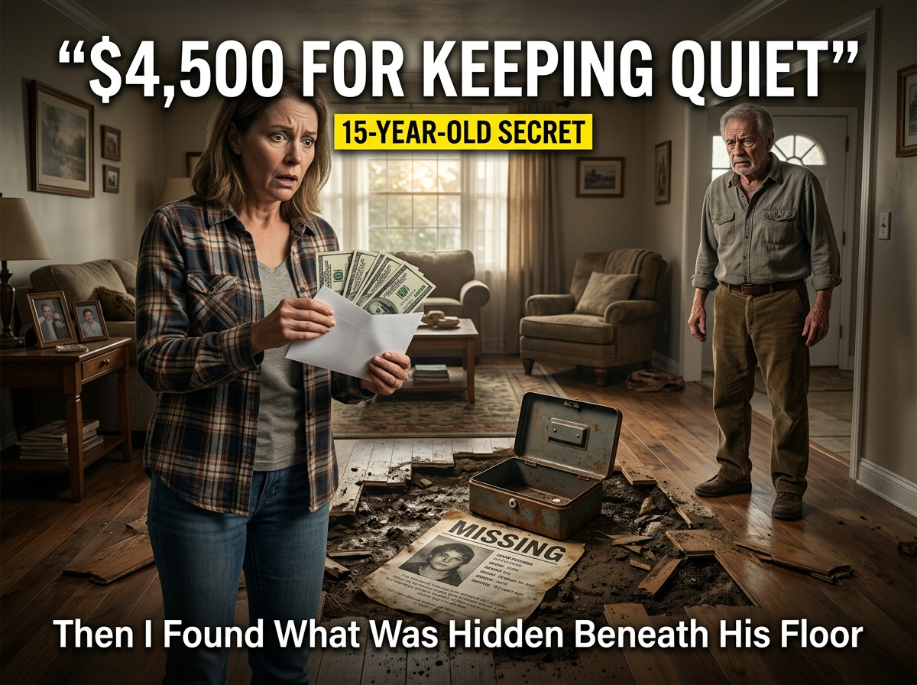
Inside were forty-five crisp hundred-dollar bills.
For several seconds, I simply stared.
I counted them once.
Then again.
Four thousand five hundred dollars.
There was also a small handwritten note.
Only four words.
“For keeping quiet.”
I read it three times.
My first thought was that it had been put in the wrong mailbox.
My second was that someone was playing a joke.
My third was that I should put the money back exactly where I’d found it and pretend none of this had happened.
But then I looked across the street again.
At Mr. Henderson’s house.
And suddenly, for the first time in five years, the quiet gray house seemed different.
Part 2
I carried the envelope inside and placed it on the kitchen table.
I didn’t touch the money again.
Instead, I stood there staring at it.
Four thousand five hundred dollars.
Cash.
Crisp hundred-dollar bills.
And a note that suggested I had done something.
Or, more unsettlingly, that I had seen something.
I hadn’t.
At least, not that I knew of.
I hadn’t spoken to Mr. Henderson in weeks.
Our last conversation had been so ordinary that I couldn’t even remember the exact words.
Something about the weather.
Something about the neighborhood.
He had mentioned that his knees were bothering him when the temperature dropped.
That was it.
Nothing about money.
Nothing about secrets.
Nothing about anything worth paying someone to keep quiet about.
I picked up the note.
The handwriting was small and deliberate.
“For keeping quiet.”
I wondered whether the money was actually from Mr. Henderson.
Maybe someone else had put it there.
Maybe someone had made a mistake.
Maybe this was connected to some kind of crime.
That thought made me immediately put the note down.
I walked to the window.
Across the street, everything looked normal.
Mr. Henderson’s curtains remained closed.
His front porch was empty.
His lawn looked exactly as it always did.
A lawn mower sat beside his garage.
A newspaper lay near his front steps.
Nothing appeared wrong.
That was what bothered me most.
If something terrible was happening, there should have been some sign.
But the house gave me nothing.
I returned to the kitchen.
I picked up the envelope again.
The bills were real.
At least, they appeared real.
I wasn’t about to test that theory.
I thought about calling the police.
Then I imagined explaining the situation.
“Hello. I found $4,500 in my mailbox.”
“Where did it come from?”
“I don’t know.”
“Who gave it to you?”
“My neighbor.”
“Why?”
“I don’t know.”
“What did you do?”
“I walked around my kitchen for twenty minutes.”
It sounded ridiculous.
Still, I knew one thing.
The money didn’t belong to me.
So I made a decision.
I would return it.
Immediately.
I put the bills back into the envelope, slipped the note inside, and crossed the street.
As I walked toward Mr. Henderson’s house, I noticed how unusually still the neighborhood was.
No children.
No cars passing.
No lawnmowers.
Just the sound of my shoes against the pavement.
I climbed the three steps to his porch.
“Mr. Henderson?”
No answer.
I knocked.
“Mr. Henderson?”
Still nothing.
I reached for the doorbell.
Then I noticed the front door wasn’t completely closed.
It was slightly ajar.
I frowned.
That wasn’t like him.
Mr. Henderson was careful about his house.
I knew because he had once complained about a neighbor leaving a garage door open overnight.
“Mr. Henderson?”
I pushed the door open a little farther.
“It’s me.”
Nothing.
I stepped inside.
The house smelled different.
Not bad.
Just different.
There was a faint scent of dust and something earthy underneath it.
I stood in the entryway.
His furniture looked familiar.
The old coat rack.
The wooden cabinet.
The framed photographs along the wall.
But something immediately felt wrong.
The living room.
I could see it from the hallway.
The hardwood floor was gone.
Completely gone.
Every board had been ripped up.
The room looked as though someone had torn open the floor and then simply walked away.
Dirt showed beneath the missing boards.
Dark, uneven earth.
I stared.
For a moment, I forgot about the envelope in my hand.
Then I saw what was sitting in the middle of that exposed foundation.
A metal lockbox.
It was open.
Empty.
And underneath it was a piece of paper.
Old.
Yellowed.
Partially folded.
I took one cautious step forward.
Then another.
I didn’t know why.
Maybe because I had already crossed the line between ordinary neighbor and unwilling witness.
Maybe because the money in my hand suddenly seemed connected to everything in front of me.
I lowered my eyes.
The paper beneath the lockbox was a flyer.
A missing persons flyer.
And at the top was a date.
Fifteen years old.
My heart began beating faster.
I leaned closer.
There was a photograph.
I looked at the face.
And my blood ran completely cold.
Part 3
For several seconds, I couldn’t move.
The room seemed to shrink around me.
The open lockbox sat in the dirt.
The torn-up hardwood floor surrounded it.
The old missing persons flyer lay beneath it like something deliberately hidden and then forgotten.
And the photograph stared back at me.
I had seen enough missing-person flyers over the years to know what they usually looked like.
A smiling face.
A name.
An age.
A description.
A telephone number.
Sometimes a reward.
Sometimes a desperate plea from a family.
But this one was different.
Not because of the paper.
Because of the feeling it gave me.
There are moments when your mind understands something before your heart is ready to accept it.
I stood there with the envelope containing $4,500 in my hand and suddenly remembered every conversation I had ever had with Mr. Henderson.
Every harmless question.
Every moment he had watched the street from his porch.
Every time I had assumed that his quietness was simply the personality of an old retired teacher.
What if it wasn’t?
What if quiet wasn’t the same thing as peaceful?
I swallowed.
I looked toward the hallway.
“Mr. Henderson?”
My voice sounded strange in the empty room.
There was no answer.
I stepped backward.
For the first time, I wondered whether I should leave.
I should have left.
I should have taken the envelope, walked home, locked my door, and called the police.
But I couldn’t.
Something kept pulling my attention back to the flyer.
I crouched beside it.
The photograph was old, but clear enough.
The person in the picture looked young.
Too young.
The image had been taken years ago.
I read the printed information.
Then I read it again.
My fingers tightened around the envelope.
The words on the page seemed to blur.
I couldn’t understand how the photograph connected to Mr. Henderson.
I couldn’t understand why it was beneath his living room.
And I couldn’t understand why someone had given me $4,500 with the words “For keeping quiet.”
Except there was one thing I suddenly understood.
Someone believed I knew something.
Maybe someone believed I had seen something.
Maybe someone believed Mr. Henderson had told me something.
But he hadn’t.
At least, he hadn’t told me anything I knew was important.
I thought about the weeks when I hadn’t spoken to him.
I thought about how his behavior had changed slightly before that.
He had stopped sitting on his porch.
He had stopped waving.
I had assumed he was simply tired.
Now I wondered whether he had been waiting.
Waiting for something.
Or someone.
I heard a sound from outside.
A car door closing.
I froze.
Then footsteps.
Someone was walking along the sidewalk.
I stood up quickly.
The footsteps continued.
They passed the house.
Then faded.
I exhaled.
My hands were trembling.
I looked down at the floor again.
Why had he removed the hardwood?
Why was there a lockbox?
Why was the lockbox empty?
And why was the missing persons flyer underneath it?
The questions came faster than I could answer them.
I walked toward the hallway.
“Mr. Henderson?”
Nothing.
I called again.
Still nothing.
I checked the kitchen.
Empty.
The back door was closed.
I checked the small hallway bathroom.
Empty.
Then I returned to the living room.
I couldn’t leave the flyer behind.
I didn’t know why.
Perhaps I was afraid someone would destroy it.
Perhaps I was afraid I would never see it again.
I bent down.
Before I could touch it, I noticed something written on the back.
A date.
And beneath it, a few handwritten words.
I leaned closer.
The handwriting looked familiar.
Not exactly like the note in my mailbox.
But close enough to make my stomach tighten.
I looked toward the front door.
The house suddenly felt less like a home and more like a place where someone had been keeping a secret for a very long time.
Then I heard the front door move.
I spun around.
Someone had entered the house.
Part 4
“Mr. Henderson?”
The word came out almost as a whisper.
The front door slowly opened.
For one terrible second, I expected to see a stranger.
Someone who had come for the flyer.
Someone who knew about the money.
Someone who knew I had found the lockbox.
Instead, Mr. Henderson stood in the doorway.
He looked older than he had the last time I saw him.
Not simply older.
Exhausted.
His gray hair was uncombed, his shirt was wrinkled, and one hand gripped the doorframe for support.
He stared at me.
Then his eyes moved to the envelope.
His face changed.
“You found it.”
I didn’t know what to say.
“I came to return this.”
I held up the envelope.
He didn’t take it.
Instead, he looked at the exposed floor.
Then the lockbox.
Then the flyer.
His shoulders seemed to sink.
“How much did you see?”
I stared at him.
“Excuse me?”
“The paper.”
I looked down.
“The missing persons flyer?”
He closed his eyes.
For a moment, he looked like a man who had finally reached the end of something.
“I didn’t know anything about this,” I said. “I swear.”
He opened his eyes.
“I know.”
“Then why did you send me the money?”
“I didn’t.”
That answer stopped me.
“What?”
“I didn’t put it in your mailbox.”
I looked at the envelope.
“But this was addressed to me.”
“I know.”
“You know?”
He stepped inside and closed the door behind him.
The click of the latch sounded much louder than it should have.
“I know your mailbox,” he said quietly. “I know where it is. I know when you usually get home. I know what time the mail arrives.”
I stared at him.
That wasn’t comforting.
“Why?”
He didn’t answer.
Instead, he walked slowly into the living room.
He stopped beside the exposed foundation.
For several seconds, he looked at the lockbox.
Then he said, “I haven’t opened that box in fifteen years.”
I looked at the empty metal container.
“But it’s open.”
“Yes.”
“Who opened it?”
“I don’t know.”
The room seemed colder.
“You didn’t open it?”
“No.”
“Then who did?”
He looked at me.
“I was hoping you wouldn’t ask me that.”
I felt anger rising beneath my fear.
“Mr. Henderson, I found four thousand five hundred dollars in my mailbox with a note saying it was for keeping quiet. Then I came over here and found your floor ripped up and a fifteen-year-old missing persons flyer under an empty lockbox.”
I held up the envelope.
“I think I deserve some answers.”
He didn’t argue.
Instead, he sat on the edge of an old chair near the wall.
His hands trembled slightly.
“I was a teacher,” he said.
“I know.”
“I taught history for forty-two years.”
“I know that too.”
“I spent my whole life telling young people that the truth mattered.”
He looked at the floor.
“And then I spent fifteen years learning what the truth can cost.”
I didn’t speak.
He rubbed his hands together.
“There was a student.”
The word made my chest tighten.
“A student?”
He nodded.
“Fifteen years ago.”
He looked toward the flyer.
“I can’t tell you everything.”
“Why not?”
“Because I don’t know everything.”
That answer sounded painfully honest.
“What happened?”
His eyes remained on the paper.
“She disappeared.”
I looked down at the photograph.
“Was she your student?”
“Yes.”
“What was her name?”
He didn’t answer.
His silence told me the question had struck something deep.
I stepped closer.
“Mr. Henderson.”
He looked at me.
“She came to me because she was afraid.”
The room became completely still.
“What was she afraid of?”
His jaw tightened.
“I thought I could protect her.”
The words were barely audible.
“But I couldn’t.”
I looked at the lockbox.
“What was in there?”
“Evidence.”
“What kind?”
“Things that proved she hadn’t simply run away.”
My breath caught.
“Then where is it now?”
He looked at the empty box.
“Gone.”
“Who took it?”
“I don’t know.”
“And the money?”
“I didn’t send it.”
“Then who did?”
Mr. Henderson looked directly at me.
“That is the question I’ve been trying to answer.”
A long silence followed.
Then he said something that made my stomach drop.
“You weren’t supposed to receive that envelope.”
Part 5
I didn’t understand what he meant.
“What do you mean I wasn’t supposed to receive it?”
Mr. Henderson looked toward the window.
“Someone wanted to scare you.”
“Why me?”
“I don’t know.”
“You just said I wasn’t supposed to receive the envelope.”
“I said you weren’t supposed to receive it from whoever sent it.”
“That doesn’t answer my question.”
He sighed.
“You live across the street.”
I stared at him.
“That is your explanation?”
“No.”
He looked tired.
“You have been here for five years.”
“Yes.”
“You’ve seen things.”
“Like what?”
“People coming and going.”
I shook my head.
“I haven’t seen anything.”
“Maybe you don’t remember.”
“Remember what?”
He didn’t respond.
That silence frightened me more than any answer could have.
I walked to the window.
From there, I could see my own house across the street.
My mailbox stood near the curb.
Ordinary.
Harmless.
But now it looked different.
Someone had placed that envelope there.
Someone had known where I lived.
Someone had known my name.
And someone had apparently known enough about Mr. Henderson to connect me to him.
I turned around.
“Tell me about the student.”
He looked down.
“She was intelligent.”
A faint smile appeared on his face.
“She was always asking questions.”
“What kind?”
“Difficult ones.”
“About school?”
“About people.”
He paused.
“She noticed things adults ignored.”
I thought of the missing flyer.
“What happened to her?”
“She disappeared one evening.”
“Did the police investigate?”
“Yes.”
“And?”
“They believed she had left voluntarily.”
“But you didn’t.”
“No.”
“Why?”
“Because she left something behind.”
“What?”
He looked at the lockbox.
“Her notebook.”
I felt a chill.
“What was in it?”
“Names.”
“Whose names?”
“People she was afraid of.”
I stared at him.
“And you kept it?”
“Yes.”
“Why?”
“Because I promised her.”
“You promised her what?”
His eyes filled with something I couldn’t immediately identify.
Regret.
“I promised that if anything happened to her, I wouldn’t let everyone forget her.”
I didn’t know what to say.
Outside, a car passed slowly.
We both watched it.
It continued down the street.
Mr. Henderson waited until it disappeared.
Then he whispered, “For fifteen years, I kept what I knew to myself.”
“Why?”
“Because I was afraid.”
“Of who?”
He didn’t answer.
Instead, he looked at the money.
“Someone is telling me they know I still have something.”
“But the box is empty.”
“Yes.”
“Then what do they think you have?”
He looked at me.
“I don’t know.”
I noticed his expression.
There was something he wasn’t saying.
Something important.
“You said the evidence is gone.”
“Yes.”
“Then why did someone send money to me?”
“I don’t know.”
“Why the words ‘For keeping quiet’?”
“I don’t know.”
“Why was the floor ripped up?”
“I don’t know.”
He lowered his head.
“That is the truth.”
I believed him.
That was the frightening part.
He wasn’t hiding an answer.
He was trapped inside the same mystery I was.
I looked again at the missing persons flyer.
“Can I see the name?”
He hesitated.
Then nodded.
I crouched beside the paper.
The photograph was faded.
The printed information was worn.
I studied it carefully.
The person in the photograph looked young.
Too young to have become a forgotten name.
I wondered how many years Mr. Henderson had carried that piece of paper.
Fifteen.
Fifteen years of waking up every morning knowing that someone had disappeared.
Fifteen years of remembering a student who had asked him for help.
Fifteen years of wondering whether he had failed her.
I stood.
“You should call the police.”
He looked at me.
“I have.”
“When?”
“Fifteen years ago.”
“And now?”
His face hardened.
“Now I’m not sure who I can trust.”
I looked toward the empty lockbox.
Then toward the front door.
Then at the envelope in my hand.
“What do you want me to do?”
He didn’t answer immediately.
Finally he said, “Go home.”
“That’s it?”
“Yes.”
“And the money?”
“Take it with you.”
I stared at him.
“I don’t want it.”
“Neither do I.”
“Then why would I keep it?”
He looked at me with an expression I couldn’t understand.
“Because whoever sent it wants you to think it has something to do with me.”
“And it doesn’t?”
“I never said that.”
I felt my stomach tighten.
Before I could ask another question, a sound came from outside.
A sharp metallic click.
Mr. Henderson’s face changed instantly.
He stood.
“Get away from the window.”
Part 6
I didn’t move.
“What was that?”
“Please.”
His voice was different.
Not the voice of the retired teacher who used to joke about his knees.
This was the voice of someone who had spent fifteen years expecting danger.
I stepped away from the window.
Mr. Henderson moved toward the curtains.
“Don’t touch them,” I said.
He stopped.
For several seconds, neither of us spoke.
Then a car drove slowly past the house.
We waited.
It continued around the cul-de-sac.
Mr. Henderson didn’t relax.
I looked at him.
“You knew something like this might happen.”
He shook his head.
“I knew something might happen.”
“What?”
“I don’t know.”
The uncertainty in his voice was unbearable.
I placed the envelope on a table.
“I can’t just go home.”
“You can.”
“No.”
He looked at me.
“You don’t understand.”
“Then explain it.”
He sat down.
I remained standing.
For the first time, I noticed how small he seemed.
The man I had always seen from across the street had seemed solid.
Reliable.
Almost permanent.
Now he looked fragile.
“I spent years believing that keeping quiet would protect her,” he said.
“Her?”
“The girl.”
I nodded.
“And did it?”
He looked at the flyer.
“No.”
“Then what did keeping quiet accomplish?”
His eyes closed.
“Nothing.”
That one word seemed to break something inside him.
I sat opposite him.
“You should have told someone.”
“I did.”
“You told the police.”
“Yes.”
“And?”
“They didn’t believe what I believed.”
“What did you believe?”
“That she didn’t disappear voluntarily.”
He looked at me.
“That someone made sure she disappeared.”
I felt a knot forming in my stomach.
“Did you know who?”
“I suspected.”
“Who?”
He shook his head.
“I never had enough proof.”
“Was that what was in the lockbox?”
“Yes.”
“Then why is it empty?”
“I don’t know.”
“You’ve said that three times.”
“Because it’s true.”
I leaned back.
“What was the last thing you saw her do?”
His eyes moved toward the floor.
“She came to my classroom after school.”
“Fifteen years ago?”
“Yes.”
“What did she say?”
He swallowed.
“She said she was in trouble.”
“What kind of trouble?”
“She wouldn’t explain.”
“Did she name anyone?”
“No.”
“Then why did you believe someone had hurt her?”
“Because she asked me to hide something.”
I stared at him.
“What?”
He didn’t answer.
He looked toward the empty lockbox.
Then I understood.
“The notebook.”
He nodded.
“She gave it to me.”
“What happened afterward?”
“She left.”
“And you never saw her again?”
“No.”
“Did she say goodbye?”
“No.”
“Did she say where she was going?”
“No.”
“Did she seem afraid?”
“Yes.”
“How afraid?”
He looked at me.
“Afraid enough to look over her shoulder while she was talking to me.”
The room fell silent.
I imagined a fifteen-year-old standing in this house years earlier, trusting her teacher enough to hand him something she believed could keep her safe.
Then I imagined him opening the same lockbox again fifteen years later.
Except someone had beaten him to it.
Someone had ripped up his floor.
Someone had taken whatever remained.
And somehow, $4,500 had appeared in my mailbox.
I stood.
“I need to see the flyer again.”
He nodded.
I crouched beside it.
This time I noticed something I had missed before.
There was a small handwritten notation in one corner.
A date.
The date was fifteen years old.
Beside it were two initials.
I looked at Mr. Henderson.
“What do these mean?”
He didn’t answer.
“Mr. Henderson?”
He stared at the initials.
His face went pale.
“I haven’t seen those initials in fifteen years.”
“Whose are they?”
He slowly stood.
“I don’t know.”
“You do.”
He shook his head.
“I know what they could mean.”
“What?”
He walked toward the front door.
I followed him.
He opened it slightly and looked outside.
No one was there.
Then he turned back to me.
“The person who disappeared wasn’t the only one who knew about that lockbox.”
My heart began pounding again.
“Who else knew?”
He looked at me.
And for the first time since I had entered his house, he seemed genuinely afraid of the answer.
Part 7
I waited.
Mr. Henderson didn’t speak.
He looked toward the street as though the answer might be standing somewhere beyond the glass.
Finally, he said, “There was another person.”
“Who?”
“Someone she trusted.”
“A friend?”
“Yes.”
“Where are they now?”
“I don’t know.”
“You lost contact?”
“They disappeared too.”
The words settled heavily between us.
“Disappeared?”
He nodded.
“Not at the same time.”
“When?”
“A few months after she did.”
I stared at him.
“And you never told anyone?”
“I did.”
“Then why didn’t anything happen?”
“Because there was never enough evidence.”
I thought about the missing flyer.
The old photograph.
The empty lockbox.
The torn floor.
The envelope.
It was all beginning to feel like pieces of a puzzle that had been scattered across fifteen years.
But there was still one piece missing.
“What was in the lockbox?”
Mr. Henderson looked down.
“Her notebook.”
“You said that already.”
“Yes.”
“What else?”
He hesitated.
“Letters.”
“From whom?”
“I don’t know.”
“You don’t know?”
“They weren’t signed.”
“What did they say?”
His expression changed.
“Warnings.”
“To her?”
“To me.”
I felt a chill.
“You received letters warning you?”
“Yes.”
“About what?”
“About asking questions.”
I thought about the note.
“For keeping quiet.”
The words suddenly seemed less like a strange message and more like a warning.
“Did you receive those letters recently?”
“No.”
“When?”
“Over several years.”
“Why didn’t you tell me?”
“I barely knew you.”
That was fair.
Still, I felt something inside me shift.
For five years, I had thought our conversations were ordinary.
Maybe they had been.
Maybe I had simply been living across the street from a story I never knew existed.
“What changed recently?”
Mr. Henderson looked at me.
“What do you mean?”
“You stopped sitting outside.”
He frowned.
“I noticed.”
“You stopped waving.”
“I didn’t realize.”
“And you stopped talking to me.”
He looked genuinely surprised.
“I was trying to keep you out of it.”
“Out of what?”
He didn’t answer.
That silence was becoming familiar.
I walked toward the hallway.
“What are you doing?”
“Looking around.”
“No.”
I turned.
“Why not?”
“Because this isn’t your problem.”
“You put money in my mailbox.”
“I told you I didn’t.”
“Someone did.”
“Yes.”
“And that person knows me.”
“Yes.”
“Then it is my problem.”
He stared at me.
I could see he wanted to argue.
Instead, he looked away.
I walked slowly through the house.
The furniture was ordinary.
The photographs were ordinary.
The books were ordinary.
That somehow made everything worse.
A life can look perfectly normal while carrying something unbearable underneath it.
I returned to the living room.
The exposed earth beneath the floor looked darker now.
I knelt beside it.
“Was this always a crawl space?”
“Yes.”
“Then why rip up the floor?”
“I didn’t.”
“Someone did.”
“Yes.”
“Could they have been looking for something?”
He nodded.
“What?”
“I don’t know.”
I looked at the empty lockbox.
“Maybe they found it.”
Mr. Henderson didn’t answer.
I looked at him.
“You think they did.”
He swallowed.
“Yes.”
“What?”
“I think whatever was in the box was important enough for someone to come back after fifteen years.”
“And now it’s gone.”
“Yes.”
“Then maybe they got what they wanted.”
He looked at the envelope on the table.
“Maybe.”
“Then why send me money?”
He had no answer.
Neither did I.
The afternoon light had begun to fade.
The house became dim.
I suddenly realized how long I had been there.
“I should go.”
Mr. Henderson nodded.
“Yes.”
I walked toward the door.
Then I stopped.
“What happens now?”
He looked at me.
“I don’t know.”
“You’re going to call the police?”
“I don’t know.”
“Mr. Henderson.”
He looked tired again.
“I’ve spent fifteen years calling people who couldn’t help me.”
His voice cracked slightly.
“And I’m not sure I can survive another fifteen years of explaining the same story.”
I didn’t know what to say.
So I simply stood there.
Then he said, “Take the envelope.”
I looked back.
“Why?”
“Because if you leave it here, whoever sent it may think I still have it.”
“And if I take it?”
“They may think you do.”
That wasn’t reassuring.
But I took it.
As I stepped onto the porch, I looked back at him.
He was standing in the doorway.
For the first time, I didn’t see the retired teacher from across the street.
I saw an old man who had spent fifteen years carrying a secret he had never been able to bury.
I walked home.
Halfway across the street, I heard him call my name.
I turned.
He was still standing in the doorway.
“Don’t open your mailbox tomorrow.”
I stared at him.
“Why?”
His expression changed.
“Because I don’t think the first envelope was meant to be the last.”
Part 8
I barely slept that night.
The envelope sat on my kitchen table.
I considered throwing it away.
I considered burning it.
I considered calling the police.
Instead, I left it exactly where I had placed it.
I kept thinking about the words.
For keeping quiet.
But I had nothing to keep quiet about.
At least, not yet.
That was what frightened me.
The envelope had arrived before I knew anything.
It was as though someone had decided I was already part of the story.
I woke before sunrise.
The house was silent.
For several minutes, I lay in bed staring at the ceiling.
Then I remembered Mr. Henderson’s warning.
Don’t open your mailbox tomorrow.
I got dressed.
I didn’t go outside.
By eight o’clock, I was standing near my kitchen window.
The mail truck eventually appeared.
It stopped at the curb.
The carrier placed the mail inside my box.
Then drove away.
I didn’t move.
A strange feeling came over me.
I had spent five years checking that mailbox without thinking.
Now I was afraid of a small metal box at the end of my driveway.
Around noon, I finally crossed the street.
Mr. Henderson’s curtains were open.
I knocked.
No answer.
I knocked again.
Nothing.
I tried the door.
Locked.
I stepped back.
For the first time, his house looked completely empty.
I called his name through the door.
Still nothing.
I returned home.
The mailbox waited at the curb.
I stood several feet away.
I told myself this was ridiculous.
I was an adult.
I wasn’t going to be controlled by a piece of paper.
I walked toward it.
Then stopped.
Something white was sticking out.
My heart dropped.
I didn’t touch it.
I went inside and called the police.
The officers arrived later.
I explained everything.
The envelope.
The money.
The note.
Mr. Henderson.
The floor.
The lockbox.
The missing persons flyer.
They listened.
One officer took notes.
Another asked whether I had touched anything.
I told him I had.
He asked what.
I explained.
They went across the street.
I stayed outside.
An hour passed.
Then another.
Eventually, one of the officers came back.
“You said Mr. Henderson is seventy-two?”
“Yes.”
“He isn’t there.”
“I know.”
“Do you know where he went?”
“No.”
The officer looked toward the house.
“Has he ever disappeared like this before?”
“Not that I know of.”
The officer nodded.
“We’ll make some calls.”
I wanted to ask more.
Instead, I watched them leave.
That evening, the street felt completely different.
The same houses.
The same sidewalks.
The same trees.
But nothing felt ordinary anymore.
I sat on my porch.
Across the street, Mr. Henderson’s house remained dark.
I kept thinking about the missing person’s flyer.
I hadn’t taken it.
I wished I had.
But perhaps that was why Mr. Henderson had told me to leave it.
Perhaps he had known that once I touched it, I would become part of whatever had been hidden for fifteen years.
Late that night, I finally checked my mailbox.
There was another envelope.
No stamp.
No return address.
I stood under the porch light.
My hands were shaking.
I opened it.
There was no money this time.
Only a single sheet of paper.
Three words.
“You saw her.”
I stopped breathing.
I read it again.
You saw her.
But I hadn’t.
Not fifteen years ago.
Not ever.
At least, I didn’t think I had.
I looked across the street.
Mr. Henderson’s house remained dark.
Then I remembered something.
Five years earlier, when I had first moved into the subdivision, there had been an old photograph hanging in the hallway of his house.
I had seen it only once.
A group of students.
A school event.
Mr. Henderson standing behind them.
And one young face had looked strangely familiar.
At the time, I had thought nothing of it.
Now I couldn’t remember the face.
But I remembered one thing.
The girl in the photograph had been looking directly at the camera.
And something about her eyes had stayed with me.
I looked down at the message again.
You saw her.
A thought entered my mind.
Maybe I hadn’t seen her fifteen years ago.
Maybe I had seen her much later.
Maybe I had forgotten.
Or maybe someone wanted me to believe I had.
I folded the paper.
Then I heard a knock.
Not at the front door.
At the window.
I turned.
Nothing was there.
Another knock.
This time from outside the front door.
I didn’t move.
Then a voice spoke through the glass.
“Are you home?”
I recognized it.
It was Mr. Henderson.
Part 9
I opened the door.
Mr. Henderson stood on the porch.
He looked exhausted.
“You shouldn’t be here,” I said.
“I know.”
“The police are looking for you.”
“I know.”
“Where were you?”
He stepped inside.
“I needed to make sure something was still where I left it.”
“What?”
He looked at the envelope in my hand.
“You received another message.”
It wasn’t a question.
I nodded.
He read the three words.
You saw her.
His face went pale.
“Who wrote this?”
“I don’t know.”
He took a breath.
“Neither do I.”
“You have to stop saying that.”
“I wish I could.”
He sat down.
I stood across from him.
“The police came.”
“I know.”
“They searched your house.”
“I expected that.”
“They couldn’t find you.”
“I didn’t want them to.”
“Why?”
“Because I didn’t want to explain everything yet.”
I stared at him.
“You don’t get to decide that anymore.”
He looked at me.
“You’re right.”
The words surprised me.
He reached into his coat pocket.
For a moment, I thought he was going to pull out another envelope.
Instead, he took out a photograph.
Old.
Faded.
Folded at the corners.
He placed it on the table.
I looked down.
It was a school photograph.
A group of students stood outside a brick building.
Mr. Henderson was in the back.
I recognized him immediately.
Then I saw her.
The girl from the missing persons flyer.
I knew immediately.
There was no doubt.
It was the same face.
The same eyes.
The same expression.
I looked at Mr. Henderson.
“Why are you showing me this?”
“Because I think you may have seen her.”
“When?”
He didn’t answer.
I studied the photograph.
There were many faces.
Students.
Teachers.
People standing in the background.
Then something caught my attention.
A house.
At the far edge of the photograph.
It wasn’t the school.
It was a residential street.
A row of houses.
One looked familiar.
Very familiar.
I leaned closer.
My breath caught.
“Where was this taken?”
“After the school event.”
“When?”
“Fifteen years ago.”
I looked again.
The house in the background.
The shape of the porch.
The windows.
The tree near the sidewalk.
Something was wrong.
I knew that house.
I had seen it.
But not fifteen years ago.
Recently.
I stood.
“That’s impossible.”
“What?”
I pointed.
“That house.”
Mr. Henderson looked.
“Yes.”
“That’s my house.”
He stared at me.
For a moment, neither of us spoke.
I walked to the window.
My house stood across the street.
Exactly the same.
Different paint.
Different landscaping.
But unmistakably the same property.
I turned.
“How?”
Mr. Henderson didn’t answer.
I felt the room spinning.
“You told me you didn’t know why I received the money.”
“I don’t.”
“You told me I wasn’t supposed to receive the envelope.”
“Yes.”
“You said someone might be trying to scare me.”
“Yes.”
“But this photograph shows the girl standing near my house.”
“I know.”
“Why?”
He looked down.
“Because that is where she was last seen.”
I couldn’t speak.
The room seemed to disappear around me.
“My house?”
“Yes.”
“Why didn’t you tell me?”
“I didn’t know you lived there until five years ago.”
I stared at him.
“You knew the address?”
“Yes.”
“But not that I was living there?”
“No.”
I thought about moving in.
Five years ago.
The previous owner had been an older couple.
At least, that was what I remembered.
I had never thought about who had lived there before them.
I had never asked.
Mr. Henderson stood.
“There is something else.”
I looked at him.
“The lockbox wasn’t buried beneath my floor because I wanted to hide the evidence.”
“Then why?”
“Because I was told to put it there.”
“By whom?”
He looked toward the missing persons flyer.
“Her.”
My chest tightened.
“She came to me that night.”
“She was alive?”
“Yes.”
“And she told you to hide it?”
“Yes.”
“What happened after?”
He closed his eyes.
“She said someone was coming.”
“Who?”
“I don’t know.”
“You have to know something.”
“I know what she told me.”
“What?”
He looked at me.
“She said if I couldn’t protect her, I had to protect what she gave me.”
“And you did.”
“For fifteen years.”
“Until someone opened the box.”
“Yes.”
“Who?”
“I don’t know.”
I almost laughed from frustration.
Then he said something else.
“The person who opened it knew where to look.”
That silenced me.
Because the floor had been ripped up.
Not randomly.
Someone had known exactly where the box was.
I looked at the photograph again.
Then at the flyer.
Then at the envelope.
The pieces were still incomplete.
But they were beginning to form something.
Mr. Henderson moved toward the door.
“Where are you going?”
“Home.”
“Why?”
“Because I think you need to be careful.”
“I’ve been careful.”
“No.”
He looked at me.
“You’ve been curious.”
The distinction frightened me.
He opened the door.
Before leaving, he turned.
“I spent fifteen years trying to understand what happened to her.”
He looked toward the photograph.
“And now I think the answer may have been across the street from you the entire time.”
Then he left.
I remained standing in the doorway.
I looked across the street.
At his house.
At my house.
At the mailbox.
At the place where the first envelope had been waiting.
And suddenly, I understood why the photograph had made my blood run cold.
Part 10
I looked down at the photograph one last time.
The girl’s face stared back at me.
Fifteen years had passed since that photograph was taken.
Fifteen years since she had disappeared.
Fifteen years since Mr. Henderson had promised to protect what she had trusted him with.
And yet somehow, the story had found its way to me.
I thought about the envelope.
The money.
The note.
The ripped-up floor.
The empty lockbox.
The old flyer.
And the words written on the second message.
You saw her.
Maybe that was the cruelest part.
Not knowing whether I truly had.
Not knowing whether the memory existed somewhere inside me, buried beneath five ordinary years of living in a house I had never questioned.
I had always believed that a neighborhood was made from houses.
Driveways.
Mailboxes.
Porches.
People waving from across the street.
Now I understood that a neighborhood could also be made from memories.
Some were shared.
Some were forgotten.
And some were buried so deeply that people spent years walking above them without ever knowing they were there.
Mr. Henderson had spent fifteen years carrying a promise.
I had spent five years living across the street from him without understanding why he sometimes looked at me with an expression I couldn’t explain.
Maybe he had recognized something.
Maybe he hadn’t.
Maybe the truth was still buried somewhere between those two houses.
I folded the photograph carefully.
I didn’t know what would happen next.
I didn’t know who had sent the money.
I didn’t know who had opened the lockbox.
I didn’t know what had happened to the girl.
And I didn’t know whether the person who had written those three words truly believed I had seen her.
But I knew one thing.
The envelope had never really been about $4,500.
It had been about silence.
And sometimes silence isn’t empty.
Sometimes it is filled with everything people were too afraid to say.
I looked across the street one final time.
Mr. Henderson’s porch light had come on.
For the first time in years, I saw him standing beneath it.
He didn’t wave.
Neither did I.
We simply looked at each other across the street.
Two neighbors who had spent five years believing they understood the quiet life around them.
Neither of us had.
I looked back down at the photograph.
At the young face.
At the eyes that seemed to know something no one had been able to explain.
And once again, I felt the same coldness I had felt the moment I first saw the flyer beneath that empty lockbox.
My blood ran completely cold.
Because I finally understood what had frightened me from the beginning.
It wasn’t the money.
It wasn’t the note.
It wasn’t even the empty lockbox.
It was the photograph.
And the terrible possibility that, somehow, I had seen that face before.