
Part 1
Every diner has a clock that runs four minutes fast, and ours hung above the pie case, ticking toward the dinner rush like it had somewhere better to be. I had been watching it since four o’clock that Friday, the way I watched it every Friday, not because I was anxious to leave, but because at 5:30 a door opened and a man walked through it, and I had gotten used to setting my day by that.
Walter came in at 5:30. Not 5:28. Not 5:35. If you had asked me to bet my tips on anything, I would have bet them on that.
He was seventy-nine years old and carried himself like a man who had been told, long ago, that posture was the last free thing a person could own. The suit was charcoal wool, the kind they stopped making around the time I was learning to ride a bike. The elbows had gone shiny. The cuffs had been let out and taken in so many times that the fabric held the ghost of every seam. He wore a tie every single week, always knotted the same way, and a gray felt hat he removed at the door and held against his chest until he reached the booth.
Not just any booth. The corner one by the window, the one with the cracked red vinyl I had been asking Gary to replace for eleven years. It was in my section. It had been in my section since the first Friday, and I would like to say I had earned it somehow, but the truth is that Walter simply walked to it, sat down, and from then on the booth and I belonged to each other.
“Evening, Walter,” I’d say, already pouring the coffee.
“Evening, Denise.”
“The usual?”
He would nod. Meatloaf special, mashed potatoes, green beans, a dinner roll he never buttered. Fourteen dollars, and back then the price crept up to fourteen-fifty, and in the last year to fifteen. But in my memory it will always be fourteen, because that was the number when I first noticed the other number.
I’m forty-seven years old. I have worked at Larkin’s Diner since I was twenty-nine, when my marriage ended and my daughter, Maddie, was still small enough to be carried on my hip. I took the job because it was hiring and because it paid every week. I stayed because I was good at it, and because after a while, staying was the only plan I could afford.
Waiting tables teaches you to read people in about nine seconds. The man who wants to be left alone. The couple who has run out of things to say. The kid pretending he isn’t nervous about the girl across the table. I could read all of them. But Walter, I never could.
He ate slowly. He never looked at his phone, and I don’t think he owned one. He watched the room the way some people watch a river, without expecting anything from it. When I brought the check, he paid in cash, folded exactly in half. Then he stood, put on his hat, said, “Thank you, Denise,” and walked out into the evening.
And under the saucer, every week, without fail, there was a hundred-dollar bill.
The first time it happened, I thought it was a mistake. I chased him to the parking lot, waving the bill like a flag. He stopped, turned, looked at me for what felt like a very long time, and said, “It isn’t a mistake.” Then he got into his old Buick and drove away.
That was six years ago. I never chased him again.
On the Monday it all changed, I wasn’t thinking about Walter at all. The lunch crowd had thinned, the coffee had gone burnt at the bottom of the pot, and I was wiping down the counter when the bell over the door rang and a man in a gray blazer stepped inside. He didn’t look like he wanted pie.
He looked at the room, and then at me, and he said, “I’m looking for Denise Marie Callahan.”
Nobody had said my full name out loud in years.
Part 2
I set down the rag. There is a particular kind of quiet that falls over you when a stranger says your whole name, a quiet where you start running through every bill you’ve paid late and every form you’ve ever signed.
“That’s me,” I said.
He was about fifty, with reading glasses pushed up into thinning hair and a leather briefcase he held with both hands, like it might get away. “My name is Alan Pierce,” he said. “I’m an attorney. I represented Walter Hensley.”
*Represented.* I heard the past tense before I heard anything else.
“I’m sorry,” I said. “I don’t know a Walter Hensley.”
Something softened in his face. “I think you know him as Walter. He sat in that corner booth, I believe. Fridays at five-thirty.”
The counter was cold under my palm. I remember that. I remember pressing my hand flat against it as if the floor had tilted and I needed something to be level.
“He died last Tuesday,” Mr. Pierce said quietly. “In his sleep, at home. I wanted to tell you sooner, but he was very specific. He asked that you be told in person, and he asked that it be here, at the diner, not over the phone and not at your house. He said he didn’t want you to hear it alone in a kitchen.”
I didn’t know what to do with my hands. I folded the rag. Unfolded it. Somewhere behind me, Gary, my manager, dropped a ladle in the kitchen and swore, and the sound seemed to come from another building entirely.
He had been gone two Fridays in a row last March, and I had told myself it was the flu. When he came back the third week, thinner, moving a little more carefully, I had said, “We missed you,” and he had said, “Thank you, Denise,” and left the same hundred under the saucer. I had noticed the way his hand shook when he set it down. I had noticed, and I had told myself a story about it, because the alternative was to ask, and I never asked.
“I need you to sit down,” Mr. Pierce said gently.
“I’m fine standing.”
“Denise.” It was the first time he’d used my first name. “Please.”
I sat on the nearest stool. It squeaked, the way it always does, and that small ordinary sound almost undid me.
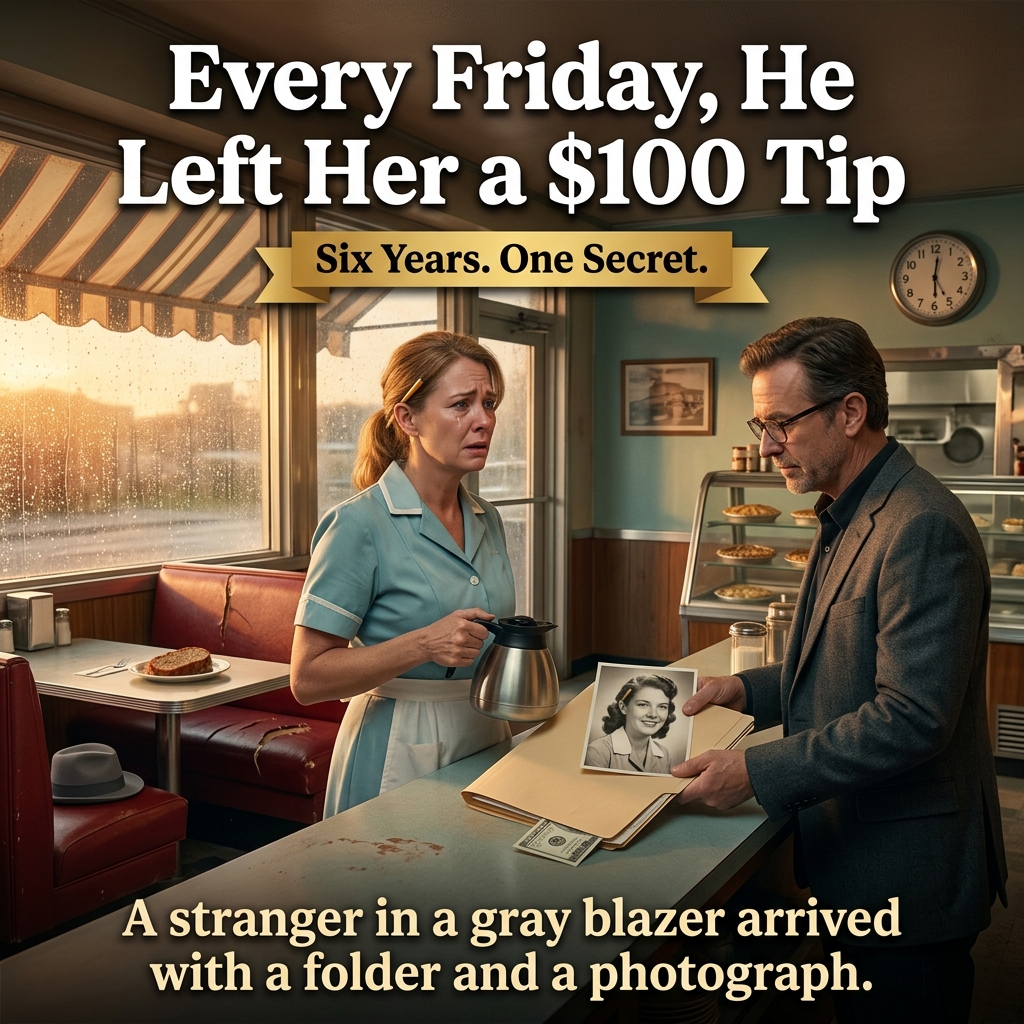
He placed the briefcase on the counter, unlatched it, and drew out a manila folder. It was thicker than I expected, sealed with a strip of red tape, and on the front, in blue ink and a hand I recognized from six years of signed receipts, was written *Denise.* Just that. No last name. No title.
“Walter’s instructions were clear,” Mr. Pierce said. “You’re to open it here, in front of me, so I can answer whatever questions I’m able to. Some I won’t be able to. He was a private man.”
“I don’t understand why he’d leave me anything.”
“You may find that the folder answers it better than I can.”
My fingers weren’t working right. It took two tries to peel back the tape. Inside were three things, laid neatly on top of each other like Walter had arranged them himself, probably at a kitchen table, probably with his hat on the chair beside him.
The first was a letter. Cream paper, several pages, folded in thirds, with a notary’s stamp pressed into the corner. I saw my name at the top and looked away, because I knew if I began reading it right then, in front of the pie case and the ticking clock, I would not be able to stop.
The second was a check. I picked it up by the edges like it might be hot. It was drawn on a bank I’d never used, made out to Denise Marie Callahan, and the amount was written twice, once in numbers and once in words, the way checks are supposed to be but rarely are.
Sixty-two thousand dollars.
I read it four times. I counted the zeros with my finger. The number did not change.
“This is a mistake,” I said, and I heard how thin my voice sounded. “He tipped me. That’s all. He was a customer. Nobody leaves a customer sixty-two thousand dollars.”
“It isn’t a mistake,” Mr. Pierce said, and my stomach dropped, because it was exactly what Walter had said in the parking lot six years earlier, in the exact same tone.
The third thing in the folder was a photograph.
It was small, black and white, with the soft, scalloped edges that photographs had a long time ago. A young woman stood on a sidewalk in front of a diner with a striped awning. She wore a pale waitress uniform with a white collar and an apron tied high at the waist, and she had a pencil tucked behind her ear. She was laughing at whoever held the camera, her head tipped a little to one side.
I didn’t recognize the diner. I didn’t recognize the street.
But I recognized the woman. Not from anywhere. From the mirror. From the photographs of myself at twenty-five, before Maddie, before the divorce. The same wide mouth, the same stubborn chin, the same crooked way of standing with all my weight on one leg.
“Who is this?” I whispered.
Mr. Pierce said nothing. He only nodded at the photograph, an invitation, and I turned it over with fingers that felt like they belonged to someone else.
Part 3
There was handwriting on the back. Blue ink, the same steady script as my name on the folder, pressed a little harder than the rest, as if the writer had wanted the words to go through the paper.
Three words.
*For Ruth. Finally.*
I read them and felt nothing at first, the way you feel nothing in the half second after you hit your thumb with a hammer. And then everything at once, though I couldn’t have told you what the everything was.
“Who’s Ruth?” I asked.
“I can’t answer that,” Mr. Pierce said. “Not because I’m hiding it. Because it isn’t mine to tell. The letter will tell you, and Walter asked that I let it.”
“*Finally,*” I said. “Finally what?”
He shook his head, gently, like a man who had been asked the same question in his own head for weeks. “I asked him once why he was doing all this. He said, ‘Alan, I’ve been trying to say something for fifty years, and I finally found someone I can say it to.'”
I turned the photograph over again. The woman in the uniform kept laughing at whoever held the camera. I had the strangest sensation, sitting there, that she was laughing at me too, kindly, in the way you laugh at a friend who has walked into a room and forgotten why.
Behind me, the kitchen door swung open. I heard Gary before I saw him, the heavy, clomping steps of a man who wears his work boots on the wrong side of his heels.
“Denise, table four’s been waiting on…” He stopped. He had seen the folder, and the man in the gray blazer, and my face. Gary is fifty-eight, and I have known him for eighteen years, and in that time I have seen him cry exactly once, at his mother’s funeral. He has a way of looking at you when something is wrong, a soft, terrified way, like he’s afraid of breaking whatever it is by naming it.
“Everything okay?” he asked.
“Walter died,” I said.
It was the first time I had said it out loud, and it sounded like a sentence in a foreign language. Gary put his hand on the counter. He said, “Oh, hell.” Then, after a moment, “Oh, Denise. I’m sorry.” And then he did something I will never forget. He turned around, walked to table four, and told the couple there that their lunch was on the house and the kitchen was closing early. He flipped the sign on the door. He pulled the shade.
“Take all the time you need,” he said, and went to the back, and I heard the sound of him blowing his nose.
Mr. Pierce waited until the door to the kitchen had swung closed. Then he slid the letter toward me.
“There’s one more thing I should tell you before you read,” he said. “Walter had no family. No children, no siblings, no nieces or nephews. His wife died a very long time ago, and he never remarried. When he named you in his will, several people advised him against it. His accountant. A cousin’s widow who came out of nowhere. They thought it was unusual.”
“It’s *insane,*” I said.
“He said it was the only sane thing he had ever done.”
I looked down at the letter. On the outside fold, in that same firm blue hand, were the words *Please read this slowly.*
“He wrote that?”
“He rewrote it eleven times,” Mr. Pierce said. “I know because I saw the drafts. He wasn’t a man who was comfortable with words. But he wanted this one to be right.”
I picked it up. The paper was heavier than I expected, expensive stationery, the kind with a slight tooth, and it smelled faintly of cedar and old coffee. I unfolded the first fold. And then, because I am a coward, and because I have never in my life wanted anything less than to read what came next, I looked up at the clock over the pie case.
It read 1:47. It was wrong, of course. It always ran four minutes fast.
But I remember thinking, with perfect clarity: *In three hours and forty-three minutes, he would have walked through that door.*
I looked down at the page, at the first line, at the beginning of a man’s confession, and I began to read.
*Dear Denise,* it said. *I owe you an apology, and you don’t yet know why.*
Part 4
*Dear Denise,*
*I owe you an apology, and you don’t yet know why. I ask you to be patient with an old man who never learned to say hard things quickly.*
*You will have noticed the photograph. I am sorry if it frightened you. The woman in it is named Ruth Ann Whitaker, and the year that picture was taken, she was twenty-four years old and working the counter at the Blue Kettle Diner in Harlan Falls, the town where I grew up. I was twenty-two and, as they say now, a mess.*
*I had come home that winter with nothing. No job, no plan, and no idea how to be a person in a quiet room. I had left town at eighteen with a duffel bag and a head full of ideas about who I’d be when I got back, and I returned with neither the bag nor the ideas. I won’t tell you where I’d been. Some things I’ve never said out loud to anyone but Ruth, and even to her I said them badly.*
*I had eleven dollars to my name. On my second night home, I walked into the Blue Kettle because it was warm and because it was the only place still open. I sat at the counter and looked at the menu for a very long time. Meatloaf was two dollars and forty cents. I had the money. But I had also learned, somewhere in the past four years, that eleven dollars is not a sum, it is a countdown, and I couldn’t make myself spend it.*
*A girl came down the counter with a coffeepot and a pencil behind her ear. She looked at me and I looked at my hands. She said, “You look like a man who’s trying to decide between being hungry and being broke.”*
*I said I supposed that was about right.*
*She said, “Well, don’t. Sit still.” And she walked away.*
*A few minutes later, a plate of meatloaf slid in front of me. Mashed potatoes, green beans, a roll. I said I hadn’t ordered it. She said, “Kitchen made too much.” I said I couldn’t pay for it. She said, “Nobody asked you to.”*
*Denise, I have thought about that plate of meatloaf nearly every day of my life since. I’m not exaggerating. I’ve thought about it in boardrooms and in hospitals, on my wedding day and on the worst day of my life. It was the first time anyone had fed me without wanting something back, and it cracked something open in me that I hadn’t known was sealed.*
I stopped reading. I had to. My eyes had gone hot and blurry, and the words ran together on the page like ink in rain.
Mr. Pierce, to his credit, said nothing. He had gotten up and moved to the far end of the counter, where he stood studying the pie case with the intense concentration of a man giving another person the gift of privacy. I wiped my face with the dish rag, which was not clean, and laughed, a wet, ugly little sound.
Meatloaf. Fridays. Fourteen dollars.
I made myself go on.
*I came back the next night, and the next. I told myself it was for the coffee. She kept sliding plates in front of me, and I kept pretending not to notice, and neither of us ever mentioned it. After a week, I got a job at the lumberyard on the edge of town. It paid poorly, but it paid. On my first Friday paycheck, I walked into the Blue Kettle with forty-one dollars in my pocket and sat at the counter and ordered the meatloaf special like a man who could afford it.*
*She looked at me and smiled, and I understood in that moment that she had known all along exactly how long it would take.*
*I told her, right then, before I lost my nerve, “Someday, Ruth, I’m going to leave you a hundred-dollar tip on a plate of meatloaf. You watch. A hundred dollars. Because that’s what it was worth.”*
*Now, a hundred dollars in that year was two weeks’ pay for me. It was a ridiculous thing to promise. She laughed so hard she had to put the coffeepot down.*
*She said, “Walter Hensley, you keep your money and buy yourself a decent coat.”*
*And I said, “No. I’m serious. I promise.”*
*She said, “Then I’ll hold you to it.”*
*Denise, I want you to understand something. I meant it. I meant it more than I have ever meant anything. And I didn’t keep it. For fifty-four years, I did not keep that promise.*
*Let me tell you why.*
Part 5
*We were married two years later, in the fall, in a church so small that half the guests had to stand in the vestibule. Ruth wore her mother’s dress, taken in at the waist, and she cried before she got to the aisle and told everyone it was allergies.*
*I worked. God, how I worked. I want to be honest with you about this, because it is the whole reason for this letter. I had been poor, truly poor, the kind of poor that follows you into sleep, and I had made myself a vow that I would never be that again, and that Ruth would never, ever know what it felt like. I took every overtime shift the lumberyard would give me. Then I took a second job. Then I saved enough to buy into a plumbing supply business with a man who later cheated me and taught me everything I needed to know to start my own.*
*Ruth kept waiting tables. I begged her to stop. I had money by then, real money, and she could have stayed home, or gone to school, or done anything at all. She said, “Walter, I like it. I like knowing who’s going to walk in. I like being the person somebody’s glad to see.” She said it was the best job in the world if you were good at it, and that she was.*
*She was. Denise, she was the best I ever saw, until I met you.*
I made a noise then, a small, strangled noise, and Gary’s head appeared briefly through the kitchen porthole and vanished again. I pressed my knuckles to my mouth and read on.
*Every Friday, I picked her up at 5:30. That was the end of her shift. I’d come from the office, tired, tie loosened, and I would sit in the corner booth by the window and order the meatloaf special, because it was Friday and because it was ours. She would bring it herself and sit across from me on her break and steal a bite of my roll. We had that, every week, for nineteen years.*
*And every Friday I would think: I should leave the hundred today. I have it now. I could leave a thousand. And every Friday I would think: Not yet. It should mean something. It should be perfect. I will do it on our anniversary. I will do it when the business turns the corner. I will do it when I have finally made her understand what she did for me.*
*I kept saying next Friday.*
*I want you to hear that phrase the way I’ve heard it in my sleep for half a century. Next Friday. Next Friday. It is the most dangerous sentence in the English language, and I said it for nineteen years.*
*Ruth got sick in the spring of our nineteenth year. It began as a tiredness she waved off, then a cough, then a doctor’s office with a soft-voiced man who used the word “advanced.” She was forty-three. She kept working for as long as she could stand, and on the days she couldn’t, she sat in our kitchen and told me which of her regulars were probably lonely and needed a little extra pie.*
*She did not complain. Not once. In the hospital, at the very end, she squeezed my hand and made me promise that I would not spend the rest of my life being sorry. I said I wouldn’t. It was a lie. It was the second promise I broke.*
*She died on a Friday. Denise, I want you to know this because it will explain many things. She died on a Friday, at 5:30 in the evening, in a hospital room with a window that faced a parking lot, and I was holding her hand, and I had a hundred-dollar bill folded in my breast pocket. I’d had it there for three weeks. I had been carrying it every day, planning to give it to her, planning to tell her everything, waiting for the perfect moment.*
*She never saw it. I never gave it. The moment I had been saving for nineteen years arrived and passed while I was still rehearsing what to say.*
The page shook in my hands. I set it down on the counter, flat, and pressed my palms against my eyes.
*I sat in that hospital room for a long time. And then I took the hundred out of my pocket and I did not know what to do with it, so I put it in the drawer of the bedside table, and I walked out, and I have never since been able to spend a Friday evening anywhere else.*
I opened my eyes.
The next line began with my name.
Part 6
*And here is where you come in, Denise.*
*For forty-eight years after Ruth died, I kept that promise the only way I knew how, which is to say I didn’t keep it at all. I threw myself into work. I sold the business and made more money than a man alone can spend. I traveled to places Ruth had wanted to see and stood in front of them and felt nothing. I ate in a great many restaurants and never once left more than fifteen percent, because it did not feel like mine to give.*
*Then, six years ago, my doctor told me that the heart I’d been ignoring had opinions of its own, and I began to think a great deal about what I had left undone.*
*One evening, in the late spring, I was driving home from the cardiologist and I got lost. I am not a man who gets lost, but I was distracted, and I ended up on a road I didn’t know, and I saw a diner. Larkin’s. The striped awning caught my eye first. Then I looked through the window, and I saw a waitress at the counter with a pencil behind her ear, laughing at something a customer had said, her head tipped a little to one side, and I stopped the car in the middle of the street.*
*I sat there, Denise, for forty minutes. A man behind me honked, and I did not move.*
*You will think I’m a foolish old man. Perhaps I am. I do not believe in ghosts, and I did not think you were Ruth. But you had her laugh. You had her way of standing with all your weight on one leg. And when I finally went inside, and you came over with the coffeepot and said, “Sit anywhere, honey,” I heard, underneath the years, a girl telling me to sit still.*
I made a sound that was half laugh, half sob. Mr. Pierce looked over at me and then quickly away.
*I ordered the meatloaf. I ate it. When I got to the register, I did what I’d been failing to do for fifty-four years. I put a hundred-dollar bill on the table.*
*I told myself it was for Ruth. And it was. But I want you to know that by the third Friday, it was also for you. Because I began to see how you were working. I saw that you knew the name of every dishwasher. I saw you slip extra fries to the boy whose father was out of work. I saw you sit for two full minutes with a woman who was crying quietly into her soup and never once ask her what was wrong. You just sat.*
*You were doing what Ruth did. You were being the person somebody was glad to see.*
*And I understood that the thing I’d promised, all those years ago, was never really about a hundred dollars. It was about noticing. It was a debt of being seen, and it could only be paid to someone who was, in her own way, still doing the seeing.*
The kitchen door creaked. I looked up, and there was Tammy, who has worked the morning shift with me for twelve years, standing frozen with a tray of clean mugs. She had obviously come in early. She took one look at my face, and at the letter, and at the man in the gray blazer, and put the tray down very quietly.
“Denise?” she said. “Honey, what happened?”
I opened my mouth to answer. Nothing came out. She crossed the floor in three steps and put her arms around me, and I let her. Her cardigan smelled like vanilla and dish soap, and I cried into her shoulder like I was seven years old.
“Walter passed,” Gary said, from the doorway, in a low voice.
“Oh, no,” said Tammy. “Oh, that sweet man.” And then, because she is Tammy, and has never held back a thought in her life, she said, “And I was so jealous of you. I said such awful things about those tips.”
“I know,” I said into her shoulder. “It’s okay. I was a little bit jealous of me too.”
She laughed, and I laughed, and Gary blew his nose again. And Mr. Pierce, at the far end of the counter, took off his glasses and wiped them slowly on his blazer.
When I could, I wiped my face and picked up the letter again. There was one more page. The handwriting had changed. It was a little shakier, as though Walter had written it later, at a different hour, on a different day.
At the top of the page it said, in capital letters, *NOW, ABOUT THE CHECK.*
Part 7
*Now, about the check.*
*I know what you’re thinking, because I know you. You are thinking that you cannot possibly accept it. You are thinking about how you’d feel taking a stranger’s money, and you are composing, in your head, a speech about pride.*
*Please put the speech away.*
*The sum is not arbitrary. You have been paid, by me, a hundred dollars a week for six years. That is thirty-one thousand two hundred dollars. I have doubled it. This is not a mathematical flourish. It is because I owed Ruth a hundred dollars for every Friday she waited on me and I sat there and did not say what I felt, and I have never been able to count that high. So I have paid what I can. It will never be enough. But it is at least a number.*
*I know about Maddie. Please don’t be frightened. You spoke to the boy who bussed your tables one Friday about how she was starting at the community college and how you’d been picking up double shifts to cover the difference. I was not eavesdropping. I was merely at the next booth, being seventy-eight, and invisible.*
*I want her to finish. I want her to finish without you counting quarters. If there is anything left, and there will be, I want you to buy a car that starts in the winter. I noticed the Corolla. I noticed the duct tape.*
I laughed again, helplessly. The Corolla. The duct tape on the side mirror. Seventy-eight years old, and he had noticed everything.
*I have one request, and it is not a condition. You may ignore it. But I hope you won’t.*
*My funeral will be small. I have arranged it that way. Mr. Pierce has the details. There will be my accountant, who will be bored, and a minister I do not know, and a woman who claims to be my late cousin’s widow and who is mostly interested in the silver.*
*I would like it very much if you came.*
*Not for me. For Ruth. She is buried in Harlan Falls, two hours north of here, under a maple tree, and I am to be laid beside her. I’ve bought the plot next to hers since the year she died, and I have visited it every Saturday morning. I have never once stood there and felt I had earned it.*
*If you came, Denise, and stood there with me, even for a minute, I think I could finally believe that she knew.*
*The funeral is Wednesday at eleven. I am sorry it is a weekday. I know you have shifts.*
*You will find the address in the folder.*
I looked up. “Wednesday,” I said. “That’s…that’s the day after tomorrow.”
“Tomorrow is Tuesday,” said Mr. Pierce gently. “Yes. It’s the day after.”
Gary said, “I’ll cover your shift.” Tammy said, “I’ll cover Gary’s shift so he can drive you.” Gary said, “I don’t need covered, I own the place,” and Tammy said, “You manage the place, Gary, there’s a difference,” and I started laughing again, and the laugh turned into crying, and Tammy put her arms around me once more.
But something else was happening under the laughing. A cold, sharp, ridiculous thought, rising like a bubble from the bottom of a pot.
*He’s been paying you a hundred a week for six years,* it said. *And there are only three people coming to his funeral.*
I turned to Mr. Pierce. “How many people will be there? Really?”
He hesitated. He was too honest a man to lie, and I watched him decide not to.
“Walter didn’t tell anyone,” he said. “He didn’t want a fuss. When I called the few people he’d listed, most of them said they were too busy to travel.” He looked at me steadily. “At this moment, Denise, it will be the minister, the accountant, and me.”
I stood up. The stool squeaked.
“No,” I said. “No, it won’t.”
Part 8
We left at seven the next morning, in Gary’s minivan, because the Corolla with its duct tape and its rattle would not have made two hours on the interstate. Gary drove. Tammy sat in the passenger seat with a thermos, and I sat in the back beside my daughter, Maddie, who had driven in from her dorm at six, still in yesterday’s sweatshirt, hair in a knot, and cried the second I showed her the photograph.
“Mom,” she said. “She looks *exactly* like you.”
“I know.”
“He tipped you a hundred dollars every Friday for six *years*?”
“I know.”
“And you never asked why?”
I looked out the window at the dark fields sliding past. “I thought if I asked, it would stop,” I said. “I thought it was one of those things that could break if you looked at it too hard.”
Maddie took my hand and held it in both of hers, the way I used to hold hers on the walk to kindergarten.
We were not the only ones in the van. In the back, wedged between a cooler and a box of paper plates, sat Rosalie, the dishwasher, sixty-one years old and four foot ten, who had shown up at the diner at dawn in her good black dress. “I’m coming,” she said, when Gary started to argue. “He always said good morning to me. Nobody says good morning to the dishwasher.” Behind her sat Luis, the night cook, who had come straight from his shift with flour still on his forearms, and a nineteen-year-old busboy named Kevin whom Walter had once helped, I learned only then, by leaving a business card for a man who ran a trade program at the community college.
By the time we reached Harlan Falls, there were eleven of us. Regulars had heard. Word had gone through the diner like water through a sieve, and people I’d served for years, a retired bus driver, a woman who came in every Sunday with her crossword, two of the mail carriers, had simply pulled on jackets and gotten into their cars.
The cemetery was on a low hill above the town, and I recognized it the moment we drove through the gate, though I had never seen it. There was the maple tree, red-gold, dropping its first leaves of the season onto the grass. Beneath it, two plots side by side. One with a granite stone, weathered and softened by decades of rain, and one with a fresh mound of earth and a small wooden marker where the stone would go.
I walked toward the older grave without meaning to. The others hung back, awkward and respectful, and I was suddenly aware of my shoes and of Gary’s tie, which he had knotted wrong.
The stone read:
*RUTH ANN HENSLEY*
*Beloved wife*
*She was the person we were all glad to see.*
I put my hand over my mouth. Beside me, Maddie made a small sound.
The minister, a young man with kind eyes and a nervous cough, came over and said quietly, “Are you Ms. Callahan? Mr. Pierce told me you might come.” He looked at the gathering behind us, at Rosalie in her black dress and Luis in his flour-dusted jacket and the mail carriers, and his face did something complicated. “Mr. Hensley told me it would be a very short service. He said there would be almost no one.”
“There’s almost no one,” I said. “There’s just everyone.”
He laughed, startled, and then wiped his eyes.
The service was ten minutes long. The minister read a psalm and said a few things about a man he had never met. Then he paused and asked if anyone wished to speak. There was a long silence, the wind moving through the maple leaves.
I had not planned to say anything. I am not a person who speaks at things.
But my feet moved. I stepped forward, held the photograph against my chest, and heard my own voice come out, small and cracked.
“His name was Walter,” I said. “He came in every Friday at five-thirty. He ordered the meatloaf. He said thank you, and he never said more than that. And I want you all to know…”
I stopped. A leaf drifted down and landed on the fresh earth.
“I want you to know that I thought he was lonely,” I said. “And I think I was wrong. I think he was *waiting.*”
The minister’s cough stopped. Even the wind seemed to pause.
And it was then, as I finished, that Mr. Pierce touched my elbow and pressed something into my palm. It was a small envelope, cream-colored, sealed. It had no name on it, and it was heavier than it looked.
“Walter’s last instruction,” he whispered. “I was to give this to you only after the service. Only after you’d said what you needed to say.”
Part 9
I opened it in the car, in the cemetery parking lot, with Maddie’s head on my shoulder and Gary pretending not to watch in the rearview mirror. Inside was a folded note, and folded inside the note, crisp and old and slightly yellowed at the crease, was a hundred-dollar bill.
Not a new one. The bill had a design that hasn’t been printed in decades. It had been folded and unfolded so many times that the paper had gone soft as cloth.
I unfolded the note.
*Denise,*
*This is the hundred-dollar bill I carried in my breast pocket the day Ruth died. I found it in the drawer of that hospital table when I went back to collect her things, three days later. I’ve kept it in my wallet for forty-eight years. I could not spend it and I could not give it away.*
*I tried, once. I put it on a table in a diner in Ohio, and I got as far as the parking lot before I ran back and took it. It was not meant for a stranger. It was meant for a moment I did not have the courage to complete.*
*I think you’ll know what to do with it.*
*I think you’ll know it needs to be left for someone who deserves to be seen.*
*Thank you for being a person somebody is glad to see.*
*Walter*
I read it twice. Then I folded it back up and held the bill in my open hand, and for a while nobody in the van said anything at all.
“Mom,” Maddie said finally. “What are you going to do?”
“I don’t know,” I said, and it was the truest thing I had said in days. “I don’t know, baby. I really don’t.”
We drove home in the late afternoon. The others followed in their cars, a small loose caravan of grief and good intentions. Somewhere past the halfway point, Tammy fell asleep against the window with her mouth open, and Rosalie began to hum something quiet in Spanish, and I watched the sun turn the fields to copper and thought about a man who had carried a hundred-dollar bill for forty-eight years because he could not decide whom it belonged to.
The diner was dark when we got back, of course. It was a Wednesday, past six. Gary unlocked the door and flipped on the lights, and there it was, the same as always. The counter, the pie case, the red vinyl booths, the clock ticking four minutes fast above them all.
I couldn’t look at the corner booth.
I did the rest of the week on autopilot. Thursday I worked the lunch shift. I poured coffee and refilled ketchup and carried plates, and nobody said much to me, and I was grateful. Every hour or so I found myself glancing at the clock. Every hour, a hollow kind of ache.
Friday came the way Fridays do.
At 5:20, I was in the back, tying my apron, when Gary appeared beside me and said, in the gruffest voice he owns, “Booth six is open. I’ve held it. Nobody’s going to sit there tonight unless you say so.”
I nodded. I didn’t trust my voice.
At 5:29, I walked through the swinging door with a pot of coffee in one hand and the hundred in my apron pocket, and I stood behind the counter and stared at the front door as if it might open.
It did not open at 5:30.
It did not open at 5:35, either.
But at 5:37, the bell above the door rang softly, and a girl I did not know walked in, hunched against the cold, holding a backpack and a folded napkin that she had obviously been twisting for a very long time. She was maybe nineteen. Her eyes were red. She looked around the diner the way people do when they are trying to decide whether they have enough money to sit down.
And she walked, without looking at anyone, directly to the corner booth by the window.
Part 10
I have thought many times since about what happened next, and I have never once been able to explain it, except to say that I did not decide anything. I simply followed a feeling that seemed to have been waiting all week for me to catch up.
I picked up the coffeepot and walked over.
The girl started to stand. “Sorry,” she said quickly. “I’m sorry, is this seat taken? I can move.”
“Sit,” I said. “Stay.”
She sank back down. Up close, I could see the rest of it: the thin jacket, the chapped hands, the phone with its cracked screen that she kept turning face-down on the table like it was ashamed of itself. She had the look I knew from the inside. The look of someone doing math.
“I only need a coffee,” she said, before I could speak. “Just a coffee. I’m waiting for…” She stopped. She wasn’t waiting for anyone, and we both knew it.
I poured the coffee. Set down the cream. And then, because I had spent six years learning from a man who had spent fifty-four years learning to do exactly this, I did not ask her anything at all.
I said, “You look like a person who’s trying to decide between being hungry and being broke.”
Her face crumpled a little. Then, unwillingly, she laughed. “Is it that obvious?”
“Only to the people who’ve been there,” I said. “Don’t decide. Sit still.”
I went back to the kitchen. I did not put a ticket in. I told Luis, “Meatloaf special, extra potatoes, on me,” and he looked at me and at the corner booth and, without a word, dropped everything and began to cook.
When I carried the plate to her table, the steam curling up between us, the girl stared at it. Then she looked at me, and I watched her decide, in real time, whether it was safe to be kind to.
“I can’t pay for this,” she whispered.
“Nobody asked you to,” I said.
She ate slowly at first, and then not slowly at all. I stood at the counter and watched, and I could feel the whole diner watching too, Gary in the kitchen doorway, Tammy pretending to wipe a spotless menu, Rosalie in her apron with her hands pressed together. Nobody spoke. It was the quietest Friday in the history of Larkin’s.
When she was finished, the girl wiped her mouth with the napkin she had been twisting and sat back, and she looked, for the first time, like a person and not a problem.
“Thank you,” she said. “You have no idea. I got my last paycheck and it wasn’t enough, and then my car…” She shook her head. “I’ve been walking for two hours. I saw the light. That’s all.”
I did not say *you’re welcome.* I sat down across from her, in the seat where Ruth had once stolen bites of a dinner roll, and I took from my apron pocket a hundred-dollar bill, soft as cloth, folded and unfolded a thousand times.
I set it on the table.
“It isn’t for the meal,” I said. “The meal was free. This is…” I stopped, because there were too many words, and none of them were the right ones. I thought of a young woman with a pencil behind her ear. I thought of a man with a gray felt hat held against his chest. “It’s for whoever needed it next,” I said. “That’s all.”
She stared at it. Her hands shook. “I can’t take this.”
“You can,” I said. “It isn’t a mistake.”
I got up, and I went back to the counter, and I picked up a pen and a guest check, and on the back of it, in handwriting that was steadier than I felt, I wrote three words. I don’t know why. It was simply what came.
I slid it under the saucer, next to the money.
*For Walter. Finally.*
Walter’s check went, in the end, where he had wanted it to go. Maddie finished her degree the following spring, debt-free, and cried at graduation in the same way her grandmother-in-spirit had once cried in a tiny church, insisting it was allergies. I bought a car that starts in the winter. It has heated seats, which I did not know I could feel guilty about and have learned to love. And with the rest, and with Gary’s blessing and Tammy’s insistence, we started a small fund at Larkin’s, a jar on the counter that nobody is allowed to explain to customers. It is only for people who come in hungry and can’t say so.
The girl from the corner booth, whose name was Josie, works the morning shift now. She learned to carry four plates at once faster than anyone I’ve trained. On her first day, I gave her a pencil and told her where to tuck it, and she laughed, her head tipped a little to one side, and I had to turn away.
On the wall by the register, between the health inspection certificate and the framed dollar bill Gary hung in 1998, there is a small black-and-white photograph. A young woman in a waitress uniform, standing in front of a diner with a striped awning. On the back, in blue ink, are the words *For Ruth. Finally.* And beneath them, in my handwriting: *And for Walter.*
The corner booth is still there. I never did get the red vinyl replaced. Every Friday at 5:30, whoever walks in and needs it most is seated there, and someone brings them the meatloaf special, and no one asks for anything back.
And every Friday, when the light comes low through the window and the clock above the pie case ticks its four minutes ahead, I stand behind the counter with the coffeepot in my hand and I look at that empty seat and I think: *Next Friday is now.*
Because I understand it at last. Walter didn’t leave me a fortune. He left me a way of seeing.
And I plan to spend the rest of my life being glad to see everyone who walks through that door.